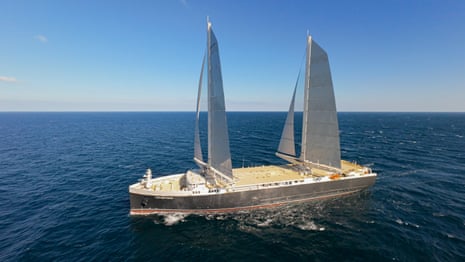
Neoliner Origin Embarks on Inaugural Voyage to Reduce Shipping Emissions
The Neoliner Origin, currently the world's largest sailing cargo ship, has departed from Saint-Nazaire in Brittany, France, on its inaugural two-week voyage to Baltimore, Maryland. The vessel is powered primarily by two semi-rigid sails made of carbon and fiberglass, supplemented by a backup 4,000 kW diesel-electric engine, aiming to reduce greenhouse gas emissions by 80% compared to an equivalent diesel-powered cargo ship.
The ship carries eight passengers, over a dozen crew members, and 1,204 tonnes of cargo, including 500,000 bottles of Hennessy cognac and refrigerated French brioche. However, three days into the journey, a top panel of one carbon sail cracked and was repaired over five days by five technicians in Saint-Pierre and Miquelon, while the front sail remained operational.
Due to the sail damage coupled with a low-pressure weather system, the Neoliner relied heavily on its 4,000 kW engine for approximately 12 days, which delayed the anticipated emissions reductions. This voyage highlighted the unpredictability of weather patterns linked to climate breakdown, which can limit the effectiveness of wind-assisted propulsion.
At 136 metres long and costing around €60 million, the Neoliner Origin is part of a new wave of sailing cargo ships but remains much smaller than typical 400-metre Suez-class carriers. Experts suggest that wind propulsion may have greater impact on smaller vessels and may not be scalable for global shipping operations. The International Council on Clean Transportation (ICCT) estimates that about 90% of shipping decarbonisation will rely on switching from bunker fuel to greener alternatives like renewable hydrogen, with the remaining 10% coming from efficiency improvements such as wind-assisted propulsion.
The ship also offers a two-week passenger crossing priced at €3,200 (~£2,800). This voyage represents a significant step in exploring how wind propulsion can contribute to greener maritime transport, despite challenges posed by weather and scale.