Organized Community Resistance to Expanded ICE Raids in US Cities in 2025
In 2025, amid an expansion of ICE and CBP raids under the second term of President Trump as part of a mass deportation operation, communities across multiple US cities have organized coordinated responses to resist immigration enforcement efforts. The raids have led to nearly 300,000 deportations and about 65,000 detentions, with operations sometimes supported by the National Guard and enabled by a Supreme Court ruling cited as facilitating racial profiling.
Cities including Chicago, Los Angeles, New York, Montgomery County (Maryland), and others have seen grassroots actions combining rapid-response networks, community support, and knowledge sharing to confront raid challenges. In Chicago's Rogers Park, the group Protect Rogers Park mobilizes volunteers to intercept raids and train for non-confrontational direct actions, using whistles to alert neighbors. Business owners like Mark Selner of Red Vault have distributed free whistles and posted signs requiring judicial warrants, both to protect patrons and deter ICE enforcement.
Los Angeles' Boyle Heights hosts Raíces Con Voz, led by Miguel Montes, which has delivered groceries to approximately 1,500 families since June while connecting them with mental health resources. In Montgomery County, Maryland, about 30 volunteers escort children during school arrival and dismissal through organized "walking school buses" coordinated via the encrypted app Signal.
New York's Mi Tlalli and court-watch volunteers document detentions, provide detainees with weekly commissary financial support, and link families to mental health services; since May, roughly 3,000 individuals have been assisted and 300 detainees aided. Street vendors, facing increased surveillance, have developed guidance distinguishing federal agents from city law enforcement, with New York's Street Vendor Project distributing whistle kits and adapting trainings.
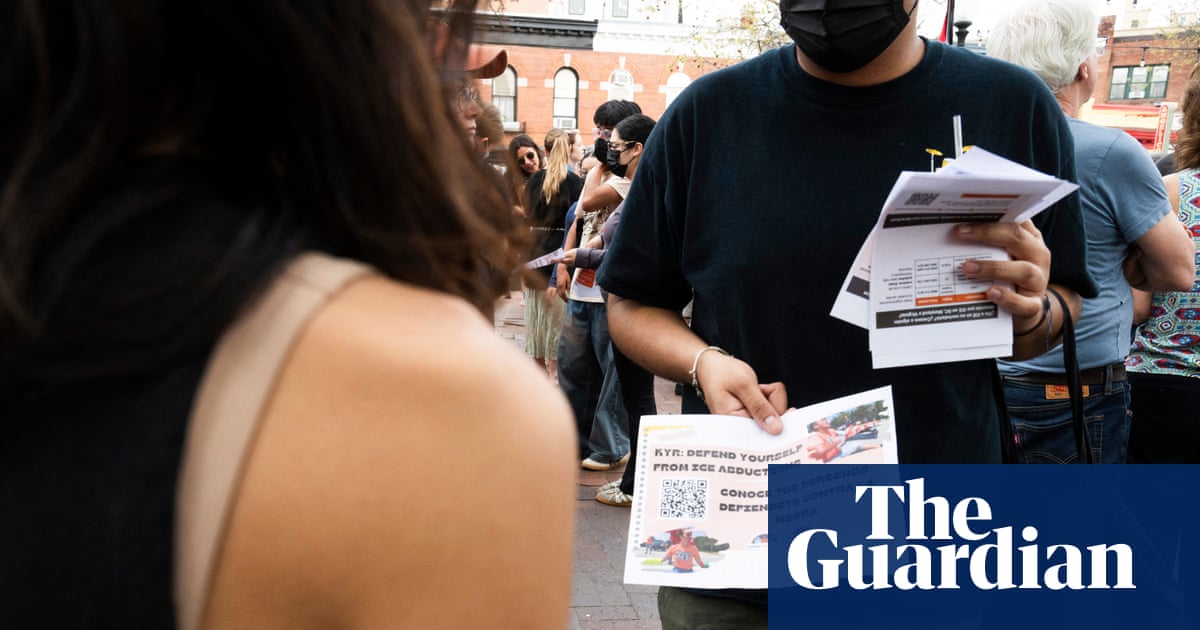
Chicago's September raids spurred local education efforts including know-your-rights sessions and whistle distribution, a tactic adopted from Los Angeles since June and spreading to New York, New Orleans, and Charlotte. Cross-city collaboration has flourished; for example, Indivisible Chicago sent whistle kits to New Orleans, which hosted a remotely-led know-your-rights training attended by about 800 people. The ACLU has facilitated exchanges among organizers in Chicago, North Carolina, and Louisiana, with plans to support future cities such as Minneapolis–St Paul.
Despite communication difficulties due to raid secrecy and concerns over external surveillance, decentralized neighborhood volunteer cells and local networks serve as primary organizing pillars instead of centralized public announcements. Organizers emphasize slowing and outlasting ICE rather than direct confrontation, reinforcing solidarity across communities and expanding resistance through city-to-city support and knowledge sharing.